
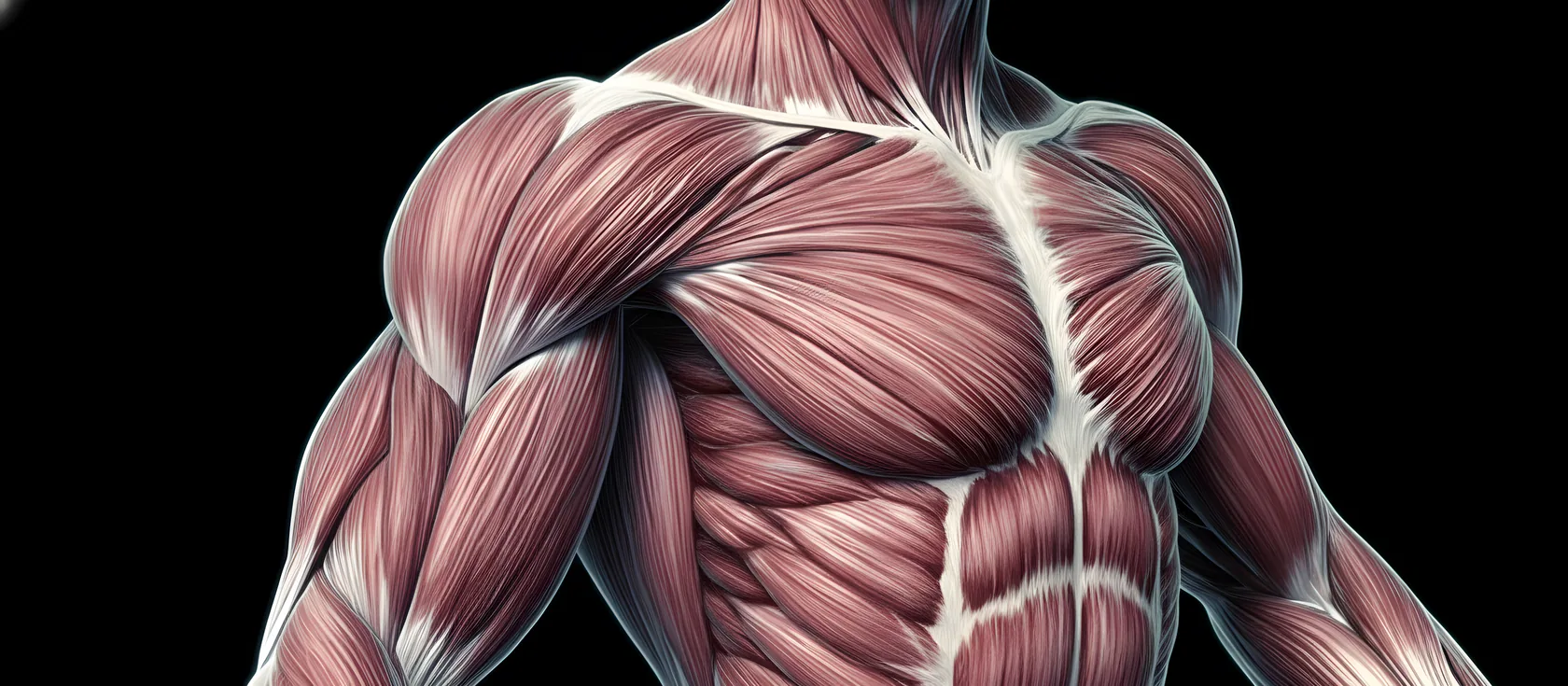
Unlimited Bio Follistatin
Muscle gains.
Without the gym.
Follistatin AAV gene therapy turns up your body's own brake-release on muscle growth. One course of injections prompts your muscle to keep producing follistatin, which blocks the signals that hold muscle back.
Follistatin gene therapy is in trial recruitment, with early-phase human data only. Experimental and not approved by the FDA. Unlimited Bio is not a medical provider; treatment is administered by independent clinics.
The biology
Your muscle has two brakes. Follistatin releases them.
Muscle size is actively held in check. Two signals, myostatin and activin, tell muscle to stop growing. Follistatin is the natural protein that binds and neutralizes both. If age-related muscle loss is your concern, our 1-minute frailty self-test (FRAIL scale) is a quick way to see where you stand.
The principle is well established in biology: animals that lack myostatin develop dramatically larger muscles (McPherron et al., 1997), and raising follistatin can increase muscle even further by also blocking activin (Lee, 2007).
How the therapy works
One course of injections, made by your own muscle
- 1
Deliver the gene
A set of intramuscular injections introduces an AAV vector carrying the follistatin gene (the FS344 isoform) into the target muscle.
- 2
Your cells make follistatin
The muscle cells take up the vector and begin producing follistatin locally and continuously, lowering myostatin and activin signaling right where it matters.
- 3
It lasts
The vector stays episomal: it does not integrate into your genome. And because muscle fibers are long-lived (the average age of human skeletal muscle is estimated at around 15 years), a single course can keep working for an extended period.
Preclinical evidence
From mice to primates
Follistatin's effect on muscle is one of the most reproducible findings in muscle biology, scaling from rodents to non-human primates.
up to ~4×
Muscle mass in mice
Boosting follistatin (blocking both myostatin and activin) increased muscle far beyond losing myostatin alone (Lee, 2007).
15+ months
Durable in primates
A single AAV1-follistatin injection drove sustained, dose-dependent muscle growth and strength in macaques, tracked over more than a year (Kota et al., 2009).
↓ fibrosis
Healthier muscle tissue
In dystrophic-muscle models, follistatin delivery reduced fibrosis and supported regeneration alongside added mass.
Clinical evidence
Tested in people, in early-phase trials
Intramuscular AAV follistatin has been studied in humans for muscle-wasting disease. The data are early-stage and the therapy remains experimental.
Phase 1/2a
First-in-human trials
Intramuscular AAV1-follistatin (FS344) was tested in Becker muscular dystrophy and sporadic inclusion body myositis at Nationwide Children’s Hospital (Mendell et al., 2015–2017).
Well tolerated
Safety record
No treatment-related serious adverse events were reported in those early-phase studies.
Farther walking
Functional gains
Most treated Becker patients improved their 6-minute walk distance, with the best responders gaining over 100 meters; biopsies showed reduced fibrosis and signs of muscle regeneration.
Early-phase trials are small and not designed to prove efficacy. Individual results vary, and outcomes in muscle-wasting disease may not predict results in healthy adults.
Safety
A widely used delivery platform, targeted action
- AAV is among the most-used gene-therapy vectors, with several approved AAV medicines in clinical use.
- Delivery is local: intramuscular injection into the target muscle, not a systemic infusion.
- The vector does not integrate into your genome; it works episomally.
- No treatment-related serious adverse events were reported in the early-phase follistatin trials.
- We screen for pre-existing AAV immunity and review your medical history before any procedure.
Follistatin: Frequently Asked Questions
Follistatin is a natural protein that binds and neutralizes myostatin and activin: two signals that tell muscle to stop growing. Raising follistatin lifts those brakes, so muscle can build and tissue fibrosis tends to fall.
As a set of intramuscular injections of an AAV (adeno-associated virus) vector carrying the follistatin gene. The targeted muscle cells then produce follistatin locally and continuously.
The AAV vector stays episomal: it sits inside the cell but does not integrate into your genome. Because muscle cells are long-lived, a single course can keep producing follistatin for an extended period; it is not a permanent edit to your DNA.
The published clinical work focused on muscle-wasting conditions (Becker muscular dystrophy, inclusion body myositis). Unlimited Bio’s interest extends to age-related muscle loss (sarcopenia) and performance. A quick way to gauge where you stand is our 1-minute frailty self-test (FRAIL scale); eligibility is then discussed on a screening call. Reach out to our team to discuss trial participation.
AAV is one of the most widely used gene-therapy delivery platforms, with several approved AAV medicines on the market. Early-phase follistatin trials reported no treatment-related serious adverse events. As with any experimental gene therapy, there are real uncertainties, and we screen for pre-existing AAV immunity and review your history before proceeding.
No. All gene therapies, including follistatin, are banned by WADA as gene doping.
The CALM-AF-AI trial (NCT07443826) is recruiting at our partner clinic GARM in Roatán, Honduras. Reach out and the Unlimited Bio team will walk you through current options and the recruitment process.
Trial registration
CALM-AF-AI NCT07443826
- Phase
- Phase 1/2a
- Status
- Recruiting
- Sponsor
- Unlimited Biotechnology LLC. Beta Building, Oficina 6, Próspera ZEDE, St. John’s Bay, Roatán, Islas de Bahía 34101, Honduras. Próspera ZEDE business permit 85125565210630.
- Study site
- GARM, Roatán, Honduras
- Registry record
- View the record on ClinicalTrials.gov
The ClinicalTrials.gov record is the authoritative one and may be updated after this page. Unlimited Bio is not a medical provider; the trial is conducted at the study site named above.
References
- McPherron AC, Lawler AM, Lee SJ. Regulation of skeletal muscle mass in mice by a new TGF-β superfamily member. Nature, 1997;387(6628):83-90. doi:10.1038/387083a0
- Lee SJ. Quadrupling muscle mass in mice by targeting TGF-β signaling pathways. PLoS ONE, 2007;2(8):e789. doi:10.1371/journal.pone.0000789
- Kota J, Handy CR, Haidet AM, et al. Follistatin gene delivery enhances muscle growth and strength in nonhuman primates. Science Translational Medicine, 2009;1(6):6ra15. doi:10.1126/scitranslmed.3000112
- Mendell JR, Sahenk Z, Malik V, et al. A phase 1/2a follistatin gene therapy trial for Becker muscular dystrophy. Molecular Therapy, 2015;23(1):192-201. doi:10.1038/mt.2014.200
- Mendell JR, Sahenk Z, Al-Zaidy S, et al. Follistatin gene therapy for sporadic inclusion body myositis improves functional outcomes. Molecular Therapy, 2017;25(4):870-879. doi:10.1016/j.ymthe.2017.02.015
- Vakhrusheva A, Nedorubov A, Leshko V, Morgunov I. Sequential VEGF-A165 plasmid and AAV-follistatin gene therapy enhances muscle hypertrophy and capillarisation in C57BL/6 mice. bioRxiv, 2026. Preprint, not peer reviewed. doi:10.64898/2026.08.26.747237
Disclaimer
Gene therapies described on this website are experimental and not approved by the FDA. Effects are not guaranteed, and individual results may vary. Therapies are provided by third parties in Próspera ZEDE (Roatán, Honduras), Mexico and the Bahamas; Unlimited Bio is not a medical provider. Always seek the advice of a qualified healthcare provider with any questions you may have regarding a medical condition or treatment.