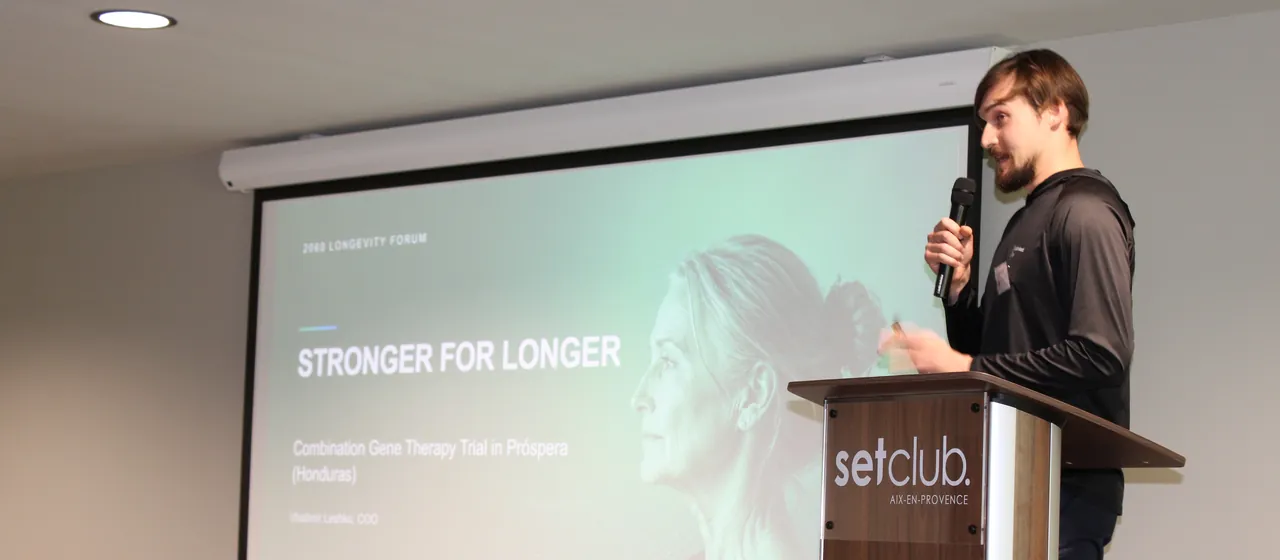
Unlimited Bio COO Vladimir Leshko at the 2060 Longevity Forum
At the 2060 Longevity Forum in Aix-en-Provence, COO Vladimir Leshko set out why muscle is a longevity target and how Unlimited Bio's CALM-AF-AI trial pairs a VEGF plasmid with AAV-follistatin.
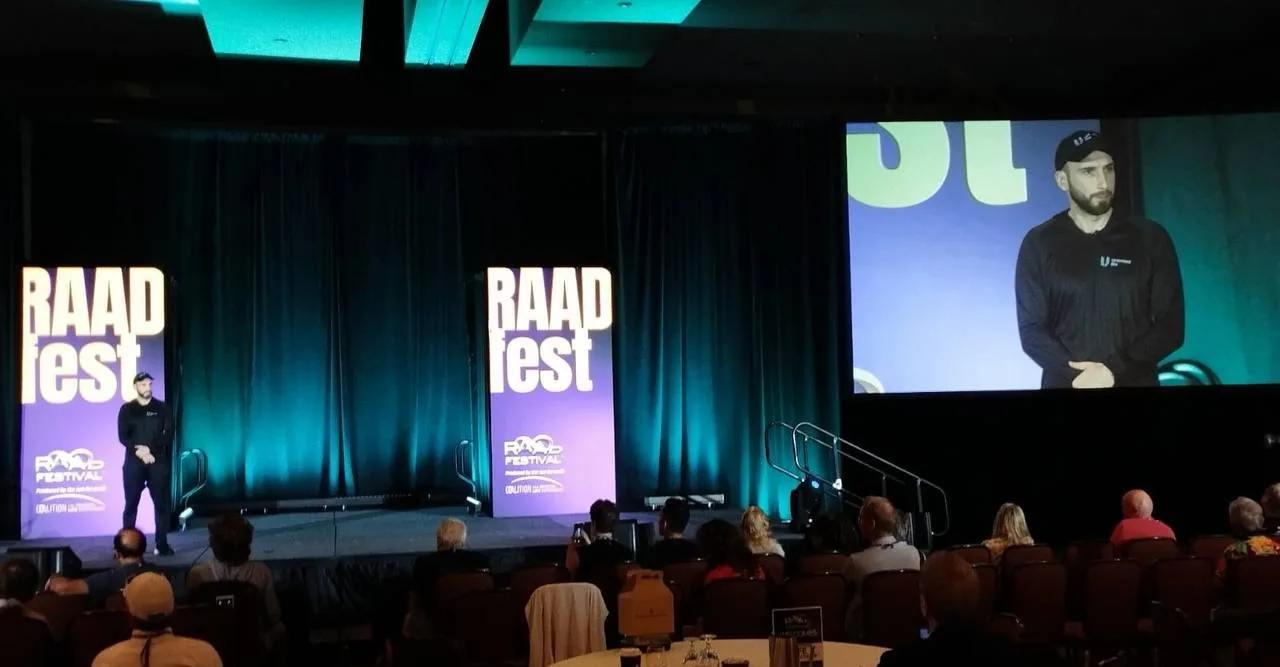
Unlimited Bio COO Vladimir Leshko spoke at the 2060 Longevity Forum, held on 2 and 3 September at Set Club in Aix-en-Provence, France. His talk on the second day, “Stronger for Longer: Combination Gene Therapy Trial in Próspera (Honduras)”, set out why Unlimited Bio treats skeletal muscle as a longevity target and how the company’s CALM-AF-AI trial is built to test that idea. The same week, CEO Ivan Morgunov made the same case on the main stage of RAADfest 2026 in Scottsdale.
About the 2060 Foundation
The forum is organised by the 2060 Foundation, based in Paris, whose stated purpose is to help humanity defeat ageing by 2060. It describes itself as a community of research scientists, venture capitalists, medical doctors and entrepreneurs who believe in radical life extension, and it works in four areas: fundamental longevity research, advocacy, bringing the longevity ecosystem together, and creating a worldwide network of longevity hubs. The foundation was co-founded by its president, Gabriel Cian, and Martial Trigeaud, and also runs the 2060 Longevity Investment Club for investors in longevity start-ups.
Now in its second year, the forum is built to put capital and science in the same room: two days for the investors, founders, scientists and policymakers building the longevity economy. This year’s published programme featured talks by Aubrey de Grey, Natasha Vita-More and Mehmood Khan of the Hevolution Foundation, panels on investment and cryopreservation, and a series of start-up pitches.
Muscle is the organ we lose first
Leshko opened with the numbers behind the talk’s title. Muscle loss begins around age 30 and accelerates after 50, running at roughly 3 to 5 percent per decade at first and faster later; commonly cited estimates put the loss by age 75 at up to half.
His argument was that strong muscle does far more than move us. Skeletal muscle takes up about 80 percent of the glucose from a meal. In a meta-analysis covering about 1.9 million adults, greater muscle strength went with lower all-cause mortality, 14 percent lower in the studies that measured leg strength, and every extra 0.1 m/s of walking speed goes with about 12 percent lower mortality after 65. In a ten-year study of 324 older female twins, greater leg power predicted better-preserved cognition a decade later, even when twins were compared with each other (Steves et al., 2016). The takeaway slide put it plainly: reversing muscle decline is one of the most direct ways to prolong health and longevity.
Four components, two targeted by the trial
Leshko broke muscle longevity into four components, each governed by its own set of genes:
- Supply: the capillary network that feeds each fibre (VEGF-A, HIF-1α, ANGPT1).
- Volume: the thickness of the fibres (follistatin, IGF-1, myostatin).
- Connectivity: the nerve supply that tells muscle to contract (agrin, GDNF, MuSK).
- Power efficiency: mitochondrial density (PGC-1α, AMPK, SIRT1).
Unlimited Bio’s current programme works on the first two.
Supply: VEGF. Vascular ageing is increasingly seen as a driver of ageing across the whole body, and VEGF signalling falls with age. In mice, counteracting that decline reduced abdominal fat, protected bone and muscle, and extended lifespan in both sexes (Grunewald et al., 2021). Exercise, the natural way to raise VEGF, gives a weaker signal with age: the rise in muscle VEGF after the same bout of exercise is roughly 50 percent smaller in older adults. The VEGF plasmid Unlimited Bio uses is made by its partner Artgen Biotech and has been approved in Russia since 2011, as Neovasculgen, for chronic lower-limb ischaemia; according to Artgen, more than 20,000 patients have been treated since it entered clinical practice in 2012. He also showed angiograms from a single patient with limb ischaemia, before treatment and six months after, as an illustration of new vessel growth.
Volume: follistatin. Follistatin blocks myostatin and activin, two of the body’s brakes on muscle growth. In cynomolgus macaques, AAV-follistatin injected into the quadriceps increased quadriceps circumference by up to 15 percent and, in one treated animal, twitch force by 26.3 percent against its untreated leg, with no abnormal changes in key organs (Kota et al., 2009). In people, the published trials of AAV-follistatin so far have been in muscle disease. A Phase 1/2a trial in Becker muscular dystrophy found it well tolerated, with walking distance improving in several patients (Mendell et al., 2015). In inclusion body myositis, the six treated patients improved by a median of 62.5 m on the six-minute walk test, while eight matched untreated patients declined by a median of 33.0 m (Mendell et al., 2017). Preclinical studies he cited, mostly in animal models of disease, also point to benefits beyond skeletal muscle: in the heart, bone and joints, fat metabolism and the liver.
Why vessels come first
Blood supply, size and strength decline together. In a 12-year study that followed the same older men, capillaries per muscle fibre fell from 1.39 to 1.08, a 22 percent drop, while thigh muscle cross-sectional area fell by about 15 to 16 percent and muscle strength by 20 to 30 percent (Frontera et al., 2000). Fewer capillaries mean less oxygen and fewer nutrients, which limits how well muscle can adapt and regenerate.
Hence the order of the combination. The VEGF plasmid goes first: its expression is designed to be transient and self-limiting, and the aim is to build a new capillary network in the target muscle. A single dose of AAV9-follistatin follows, intended to drive lasting fibre growth in tissue that is by then better supplied with blood.
Leshko presented the mouse study behind that sequence, now posted as a preprint on bioRxiv and not yet peer reviewed, and covered in more detail in our RAADfest report. In 36 mice given the VEGF plasmid on days 1 and 10 and AAV-follistatin on day 25, the order the clinical protocol uses, only the combination increased both fibre size and vessel count: it produced the largest muscle fibres of the four groups and roughly twice the vessel count of AAV-follistatin alone. Over 115 days there were no unscheduled deaths and no adverse haematological, biochemical or histopathological findings, and muscle growth stayed predominantly in the treated limb.
From the lab to Próspera
The trial runs in Próspera, on the Honduran island of Roatán, a jurisdiction Leshko described as built for accelerated research: fewer bureaucratic delays, a wider choice of indications and patient-funded trials, held to rigorous standards that include insurance, IRB oversight and GMP-like safety practice.
CALM-AF-AI is an open-label, non-randomised, multi-arm, first-in-human Phase 1/2a study in adults aged 35 to 75 with age-related muscle decline, framed as a preventive, geroscience-aligned indication. It uses a modified 3+3 dose escalation with sentinel dosing across three cohorts:
- Cohort 1: low-dose AAV-follistatin, three participants.
- Cohort 2: high-dose AAV-follistatin, three participants.
- Cohort 3: the combination, VEGF plasmid followed by AAV-follistatin, six participants.
Every step has a 21-day dose-limiting toxicity window, staggered dosing and IRB review before the next one begins. The study is under way, and no outcome data are being reported at this stage. It is registered on ClinicalTrials.gov as NCT07443826, sponsored by Unlimited Biotechnology LLC, and is recruiting approximately 12 adults at GARM in Roatán, Honduras.
What comes next
The talk closed on what could come after the current trial. If the VEGF plasmid is the fuel supply and AAV-follistatin releases the brake, the next candidates are the accelerator and the steering: an IGF-1 plasmid intended to deliver a short, potent anabolic growth pulse, and work on the neuromuscular junction, because larger fibres still need robust innervation.
Our thanks to Gabriel Cian and the whole team behind the 2060 Longevity Forum for having us, and for bringing the longevity community together in Aix-en-Provence for a second year.
These therapies are experimental and are not approved by the FDA. Unlimited Bio is not a medical provider; the trial is conducted at the study site named above, and the ClinicalTrials.gov record is the authoritative description of the protocol. The results of Unlimited Bio’s own mouse study come from a preprint that has not yet been peer reviewed.
Vladimir Leshko