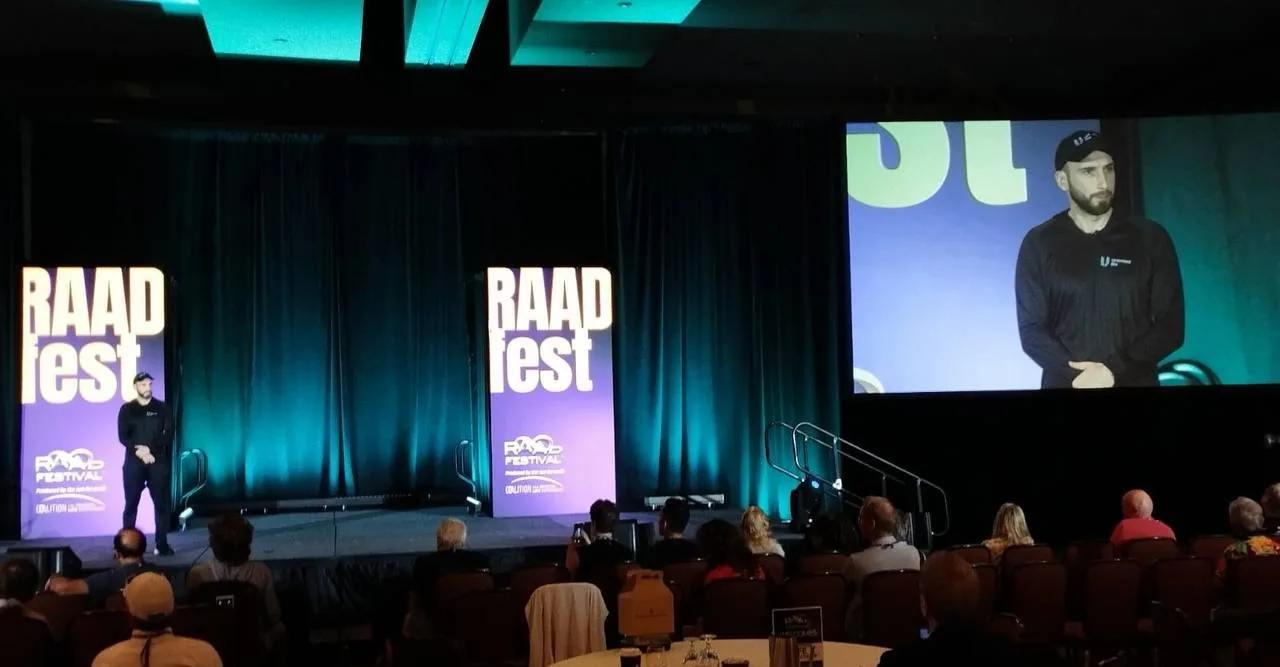
Unlimited Bio CEO Ivan Morgunov at RAADfest 2026
At RAADfest 2026 in Scottsdale, CEO Ivan Morgunov set out the case for treating muscle as a longevity target and for pairing a VEGF plasmid with AAV-follistatin rather than using either alone.
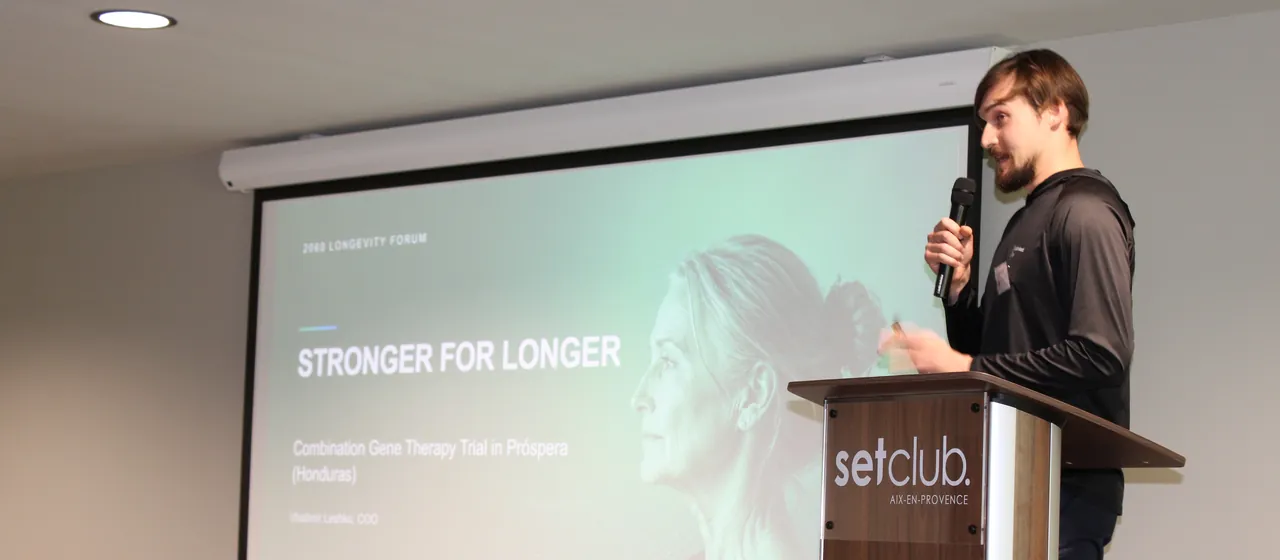
Unlimited Bio co-founder and CEO Ivan Morgunov presented at RAADfest 2026, held 4 to 6 September in Scottsdale, Arizona and produced by the Coalition for Radical Life Extension. His talk was listed on the programme as “Stronger for Longer: Combining Gene Therapies for Muscle Health and Longevity”.
It is the company’s second year on the RAADfest main stage. CTO Anna Vakhrusheva spoke there in 2025 on why combination gene therapy, rather than any single intervention, is the approach worth pursuing. This year’s talk narrowed that argument to one target: skeletal muscle, and the blood supply it depends on.
Why muscle, and why two therapies
The first half of the talk made the case for treating muscle as a longevity target rather than a cosmetic one. Muscle loss begins as early as age 30 and accelerates after 50, running at roughly 3 to 5 percent per decade at first and faster later; commonly cited estimates put the loss by 75 at up to half of muscle mass.
Morgunov’s argument was that muscle is not merely a casualty of ageing but a lever on it. Skeletal muscle handles about 80 percent of post-meal glucose uptake. In a meta-analysis covering roughly 1.9 million people, greater muscle strength went with lower all-cause mortality, 14 percent lower in the studies that measured leg strength. Myokines released by working muscle signal to bone and brain, and in a ten-year study of 324 older female twins, greater leg power predicted better-preserved cognition a decade later, even when twins were compared with each other.
The second half was about why one therapy is not enough. A 12-year longitudinal dataset he presented shows capillaries, muscle size and strength falling together: the capillary-to-fibre ratio dropping from 1.39 to 1.08, a 22 percent decline, alongside 15 to 16 percent loss of thigh cross-sectional area and 20 to 30 percent loss of knee-extensor strength. Exercise is the obvious answer, except that the VEGF response to exercise is roughly 50 percent weaker in older adults than in younger ones.
Hence the sequence: a VEGF plasmid first, to build the capillary bed, then AAV9-follistatin into tissue that can actually supply the muscle it is being asked to grow. As the talk put it, growth and perfusion are biologically coupled, so they are treated as one programme rather than two.
The preclinical result behind the trial
Morgunov also showed the mouse study the clinical sequence is built on. It is now posted as a preprint on bioRxiv and has not yet been peer reviewed.
Thirty-six C57BL/6 mice, evenly split by sex, were assigned to four arms of unequal size: PBS vehicle (n=10), AAV-follistatin alone (n=10), VEGF plasmid alone (n=6) and the combination (n=10). Each animal’s opposite hindlimb was injected with PBS and served as its own internal control. The VEGF plasmid went in on days 1 and 10 and AAV-follistatin on day 25, the same order the clinical protocol uses. A scheduled interim necropsy on day 55 took four animals from each of three arms, so the day 115 analysis rests on six mice per group.
- In the injected limb, gastrocnemius mass came out 17.6 percent heavier than the same animal’s untreated leg with the combination (p = 0.004), and that result held under correction for multiple comparisons. AAV-follistatin alone reached 11.3 percent, but at p = 0.050 the authors call it borderline rather than positive. These are local limb comparisons, not whole-body muscle gain.
- Only the combination showed both larger muscle fibres and roughly double the CD31-positive vessel counts against AAV-follistatin alone. The two effects were complementary rather than overlapping.
- VEGF pre-treatment raised the muscle-to-liver follistatin expression ratio 2.6-fold against AAV-follistatin alone, which suggests the vascular remodelling improves vector uptake where it is wanted rather than in the liver.
- Growth stayed in the treated limb: the untreated opposite leg weighed the same across all four groups (p = 0.49) and no organ weight differed, the heart included. There were no unscheduled deaths and no treatment-related haematological, biochemical or histopathological findings. Follistatin was still measurable in the blood of treated animals and the liver expressed the transgene, so the authors describe the hypertrophy as predominantly localised rather than purely local.
Where the trial stands
CALM-AF-AI, the Phase 1/2a study built on that work, is underway. Three participants have received low-dose AAV-follistatin, the first dose level in the protocol’s escalation. The study is continuing, and no outcome data are being reported at this stage.
CALM-AF-AI is an open-label, non-randomised, multi-arm, first-in-human study in adults aged 35 to 75 with age-related muscle decline. It uses a modified 3+3 dose escalation with sentinel dosing, a 21-day dose-limiting toxicity window, staggered dosing and IRB review at every escalation step. It is registered on ClinicalTrials.gov as NCT07443826, sponsored by Unlimited Biotechnology LLC, and is recruiting approximately 12 adults at GARM in Roatán, Honduras.
These therapies are experimental and are not approved by the FDA. Unlimited Bio is not a medical provider; the trial is conducted at the study site named above, and the ClinicalTrials.gov record is the authoritative description of the protocol. The preclinical figures above come from a preprint that has not yet been peer reviewed.
Vladimir Leshko